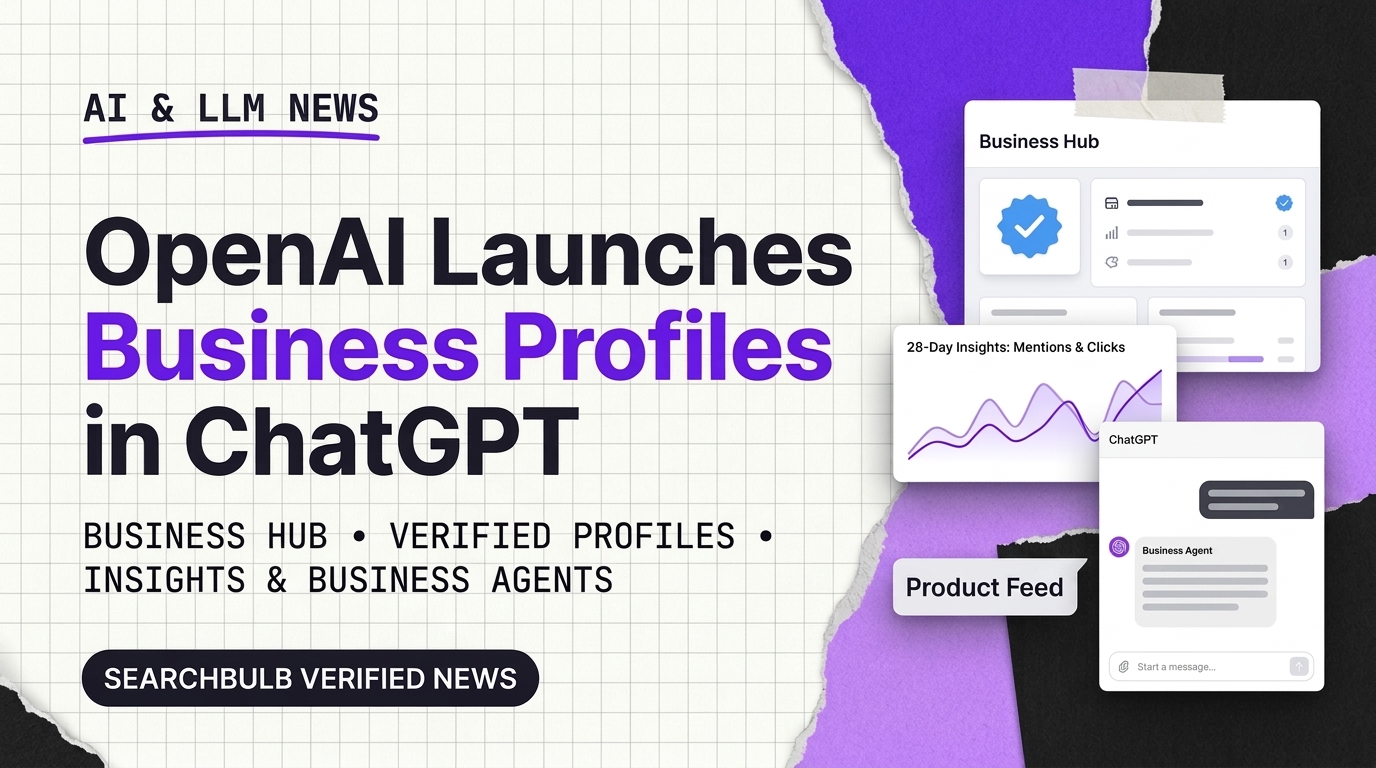
OpenAI launched Businesses in ChatGPT in beta on Tuesday, November 10, 2026. Through a new dashboard called Business Hub, eligible businesses can claim a verified profile, update their details, add product feeds, and see how often ChatGPT mentions them and sends people to their website. Eligible US ecommerce and online service businesses can also publish a Business Agent, a branded chat inside ChatGPT. Both are free for now.
What OpenAI Launched
The launch has two parts.
Business Hub is where a business claims its profile and, once verified, updates things like its description, contact details, website, and hours. Businesses can also add product feeds with prices and availability. The profile looks a lot like the information box Google shows when you search for a store, which is why TechCrunch described it as making ChatGPT “a little bit more like Google.”
Business Agents are chats that a shopper can open from a business profile after ChatGPT mentions that business. OpenAI says the conversation is labeled, separate from the shopper’s original chat, and distinct from ChatGPT’s own answers. The business supplies the information and guidelines, and OpenAI builds and runs the agent. Brands can’t bring their own.
OpenAI says ChatGPT is used by 1.2 billion people each week, and describes the launch as an early step in bringing businesses further into the product.
Who Can Claim a Profile and Who Can Build an Agent
The two features have different rules.
- Profiles: Open to eligible businesses in markets where ChatGPT is available and where OpenAI supports the required verification. Owners and authorized representatives can apply. You don’t need a ChatGPT Enterprise agreement or an ads account, and a free ChatGPT account is enough to start. Local stores and restaurants can currently claim only an existing US listing.
- Agents: Limited to eligible US ecommerce and online service businesses with a website. OpenAI’s policy says verification alone doesn’t guarantee a business qualifies. Setup guidance describes one agent per claimed profile, and it isn’t clear whether that is a hard limit.
OpenAI says it plans to add more markets and business types, and to build tools for larger organizations. It hasn’t given a timeline.
How Verification Works
At its press briefing, OpenAI didn’t spell out the process. Benji Shomair, OpenAI’s VP of Monetization, said it uses different verification methods for different business types and markets.
Reporting since then fills in the picture. Depending on the business, a claim can be verified through a business phone number, email address, website domain, or Shopify account. After the claim is approved, whoever manages the listing must also pass an identity check through Persona. That check is required before you can publish profile changes, connect a product feed, see insights, or create an agent. The blue check mark on the profile appears once it’s approved.
OpenAI’s Help Center adds that the admin who claims a business can add teammates and give an agency access.
What the Insights Show
Business Hub reports activity over the past 28 days:
- Mentions: For an online business, ChatGPT has to reference its website for a mention to count. For a local business, showing its location in a result is enough, even if nobody opens the listing.
- Website clicks: How often people click through from ChatGPT to the business’s site.
- Discovery topics: Common themes in conversations where ChatGPT cites the business’s website.
- Profile views, as reported by TechCrunch and Search Engine Roundtable.
The data is aggregated and only appears once it meets minimum thresholds. OpenAI says it doesn’t share users’ conversations or Business Agent chats with businesses. A blank metric can mean data is still being collected or reporting isn’t available yet.
Search Engine Land pointed out that click data is something Google and Microsoft don’t currently offer in their AI reporting tools. It’s still a count from inside ChatGPT only, so it won’t match your own analytics exactly.
You May Already Be Listed
One detail in OpenAI’s terms is easy to miss. OpenAI says it may create, maintain, and display a business listing whether or not the business claims it, and it may set up a Business Agent for a business before the owner chooses to use it. Publishing an agent authorizes OpenAI to make it available and promote it.
In practice, ChatGPT may already be showing information about your business. Inc. reported that businesses already listed can select their company in Business Hub and may be asked to contact support to finish claiming it.
No Visibility Guarantee, and the Link to Ads
OpenAI says ChatGPT will keep making its own independent recommendations, and that claiming a profile carries no guarantee of better placement or more sales.
The agent also connects to advertising. Businesses can sponsor their agent and use it as the destination for ChatGPT Ads, a format OpenAI began testing with selected advertisers in September. Shomair told Digiday that the free agent is “the organic experience,” and that the sponsored version should be the same agent. Digiday reported that Business Hub and agents are free for now, and that Shomair didn’t rule out charging later.
When a shopper is ready to buy, the agent sends them to the business’s own website. It can explain products and policies, but it can’t complete purchases or bookings.
The Bigger Picture
This isn’t OpenAI’s first attempt to make ChatGPT a place to shop. TechCrunch noted that an earlier effort, which let people buy products directly and charged a commission, never took off, and OpenAI retired it in March 2026. Business profiles take a different route, closer to the way people already use Google to look up a company.
What It Means for SEO and Marketing Teams
- Check what ChatGPT says about you. Since a listing may exist already, it’s worth searching for your business and correcting any wrong details.
- Treat the numbers as one data source. The insights cover one platform over 28 days, apply thresholds, and count clicks rather than visits or sales. Compare them with your analytics referral data.
- Keep your own site clear. OpenAI says claiming doesn’t give exclusive control, and ChatGPT can draw on other sources. Accurate details, prices, and policies on your website still matter.
- Don’t expect a ranking boost. OpenAI says it doesn’t promise one.
- Expect changes. This is a beta. Pricing, markets, and eligible business types are all still open.
Sources
- OpenAI’s launch announcement, covering the claim process, insights, Business Agents, and the plan to expand to more markets. — OpenAI
- OpenAI’s setup guide, including the Persona identity check and the rules for adding teammates and agencies. — OpenAI Help Center
- The legal terms behind the beta, including OpenAI’s right to display a business listing whether or not it is claimed. — OpenAI Businesses in ChatGPT Terms