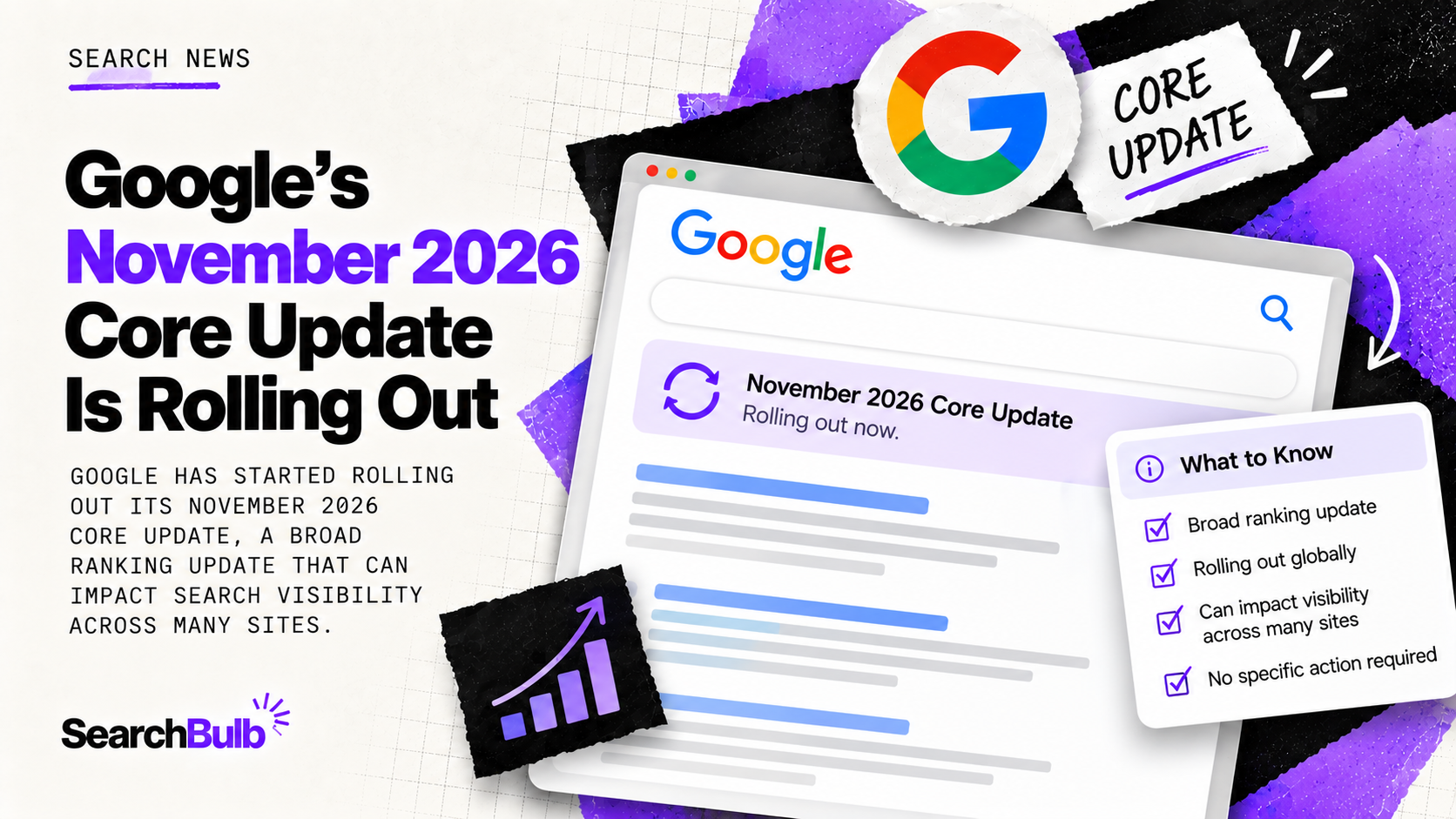
Google began rolling out its November 2026 core update on Tuesday, November 10, at around 10 a.m. Pacific. The update applies worldwide, in all languages, and Google says it may take up to two weeks to finish. It is Google’s third core update of 2026 and the first since May.
What Google Said
Google announced the update on its Search Status Dashboard and on LinkedIn. It calls this a “regular update” meant to better surface relevant, satisfying content for searchers from all types of sites. Search Engine Journal noted that this is the same wording Google used for its March core update.
As usual, Google hasn’t named a specific focus. There is no Search Central blog post about it and no list of changes. Google’s core updates documentation was last revised in December 2025, according to Search Engine Journal.
How Long It Could Take
“Up to two weeks” would end the rollout on Tuesday, November 24. Past core updates show that estimate isn’t a guarantee. Google’s dashboard lists 13 core updates since March 2023. By our count of the durations it shows, they ranged from about 6 days to 45 days, with a median of roughly 16 days. Seven of the 13 ran longer than 14 days.
The most recent ones were quicker. The March and May 2026 core updates each took about 12 days, and the December 2025 update took about 18.
Early Signs of Movement
Search Engine Roundtable reported rising ranking volatility on November 8 and 9, a day or two before Google’s announcement, with Semrush’s Sensor among the tools showing movement. Some in the community suspected a core update at the time.
Treat that as a rough signal only. Volatility tools track shifts across a large set of search results, so they can’t tell you what is happening to your own pages. Rankings also tend to move around during any rollout, and early changes can reverse.
When to Check Your Data
Google’s advice is to wait. Confirm on the Search Status Dashboard that the rollout has finished, then wait at least a full week. After that, compare that week in Search Console with the week before the rollout began, which here means the week before November 10 (for example, November 3 to 9).
Google also explains how to read the result. A small drop, such as moving from position 2 to 4, doesn’t call for drastic action, and Google recommends not changing content that is already performing well. A large drop, such as position 4 to 29, deserves a closer look at the pages that were affected.
The Holiday Problem
This update lands at an awkward time. If the rollout uses the full two weeks and ends on November 24, the comparison week runs from November 25 to December 1. That week includes Thanksgiving on November 26, Black Friday on November 27, and Cyber Monday on November 30.
Comparing that week with an ordinary pre-update week would mix holiday demand with any ranking change. Search Engine Journal raised the same point. Retail and ecommerce teams may want to also compare against the same holiday week last year and check Google Trends for demand shifts. That is our suggestion, not Google’s, though Google’s own traffic-drop guidance does list seasonality as a possible cause of lost traffic.
Is It a Penalty?
No. Google describes core updates as broad changes to its ranking systems, not actions aimed at particular sites or pages. A drop around the update doesn’t mean your site was penalized, and manual actions show up separately in Search Console.
If you do lose ground, Google says improvements can take anywhere from days to months to appear and aren’t guaranteed. Its documentation also notes that if a few months pass with no effect, a site may have to wait for the next core update.
What to Do Now
- Save your baseline. If you haven’t already, export Search Console data for the week before November 10.
- Hold off on big edits. Changes made mid-rollout make it harder to tell what caused any shift later.
- Watch for the completion notice. Google says it will update its ranking release history page when the rollout ends.
- Rule out other causes first. Check for technical changes, migrations, or a manual action before blaming the update.
The Year So Far
This is the eighth ranking update on Google’s dashboard in 2026. The earlier ones were a Discover update in February, spam updates in March, June, August and September, and core updates in March and May.