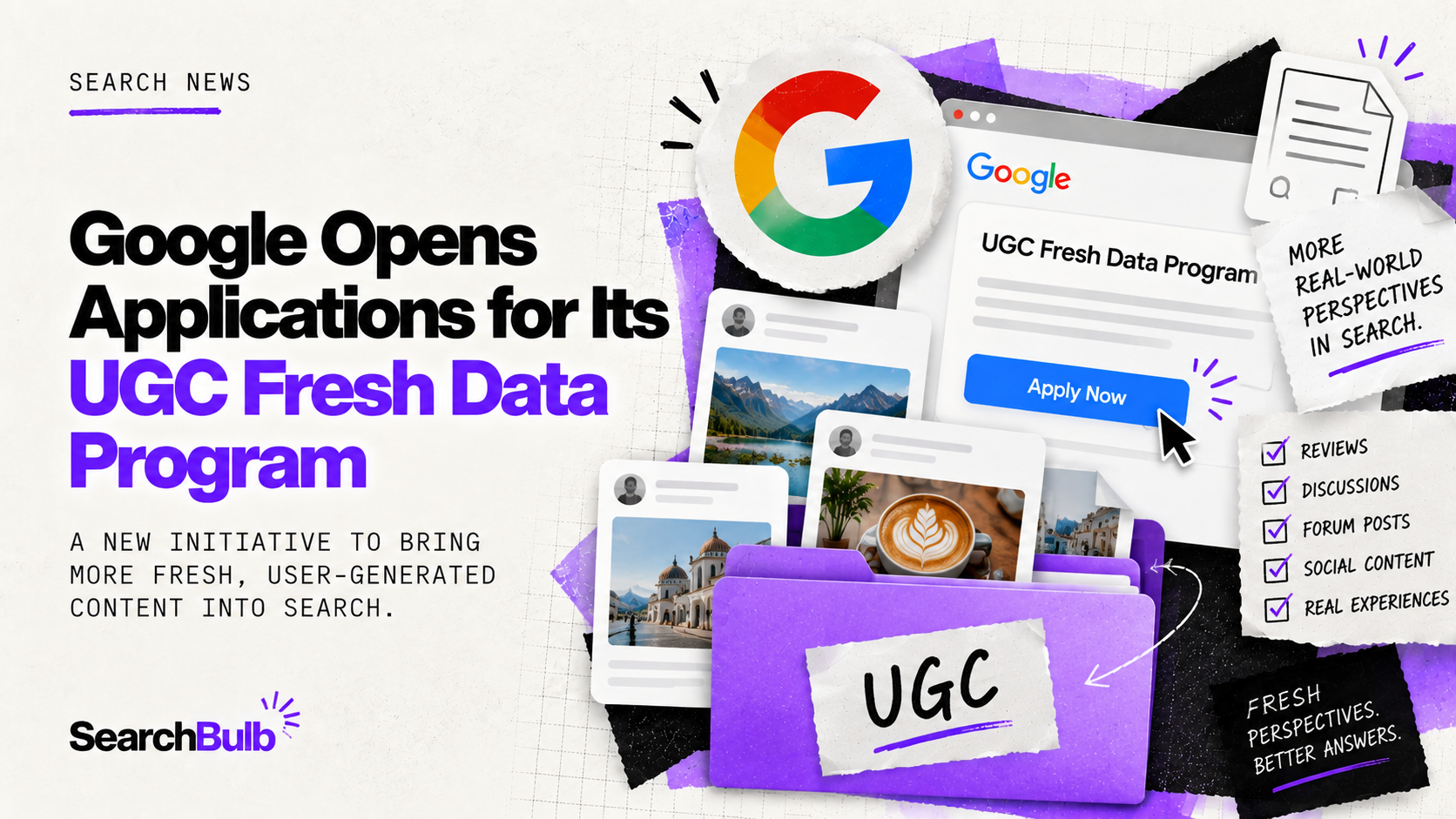
Google has published details of a new program that lets approved forums and social platforms send fresh posts and engagement data straight to Google Search, instead of waiting for Googlebot to find them. Google added the documentation on October 8, 2026, and platforms can apply now. It is built for large user-generated content (UGC) sites, not for regular business websites.
What the Program Is
Google describes the UGC Fresh Data Program as a way to help platforms get fresh, authentic user-generated content into Search features faster. Approved platforms use a dedicated pipeline to send the content itself plus interaction signals, such as likes and comments.
Google states two limits clearly. The pipeline is made only for trending UGC, and it is separate from both the Indexing API and normal crawling. Joining also comes with no promise, since Google says the program “doesn’t guarantee that content will appear in Search.”
The application form is even blunter. It calls the application an expression of interest only, and says that whether content is served is decided entirely by ranking algorithms.
How It Differs From Crawling and the Indexing API
Most content reaches Google by crawling. Timing figures reportedly shown by Google’s Gary Illyes at Search Central Live in Barcelona on October 2 put typical discovery of a new URL at about 20 hours, and a refresh of a known URL at about 30 days. Those numbers came from an attendee recap, not a Google publication, and no method was shared, so treat them as rough.
The Indexing API is Google’s existing push option, but its documentation limits it to pages with JobPosting markup or livestream BroadcastEvent markup, with a default quota of 200. The UGC program is a third route, built for a different kind of page and a tighter clock. Google asks platforms to send content ideally within minutes. It hasn’t said how fast it processes content once it arrives, so that goal only covers the sending side.
Who Can Apply: The Six Requirements
Google says participation is limited to platforms that meet its quality and volume guidelines. The requirements are:
- Content focus: The platform mainly hosts UGC, social posts, or forum discussions, each on its own page with a stable URL. Content that only lives on profile or feed pages doesn’t count.
- Volume and audience: A high volume of UGC and a large user base. Google gives no numbers for either.
- Public access: Content must be visible to Googlebot and users with no login or paywall, and every post must be tied to a creator with a public profile.
- Technical readiness: Secure OAuth 2.0 authentication, strictly validated JSON-LD payloads, and on-page schema.org markup such as SocialMediaPosting or DiscussionForumPosting with interactionStatistic fields.
- Moderation: No illegal content, active moderation, and a way for users to report content.
- Freshness: Content sent ideally within minutes, with engagement counts updated within 72 hours of a post being created.
Google’s documentation files the program under an “Early Adopters Program” section, next to package tracking. That placement fits the limited, application-only setup.
How to Apply
Platforms apply through a Google Form. Seven of its eight fields are required: company name, service domain, 10 sample URLs, monthly active users, launch date, the Search Console owner email for the domain, and a contact email. Google says the sample URLs should follow the same format you plan to send.
Google says it will reply within 6 to 8 weeks. For an application filed on launch day, that points to mid-November through early December. Technical documentation goes only to platforms that are accepted, so details like endpoints and field definitions aren’t public yet.
What Google Hasn’t Said
The documents leave several questions open:
- Which Search features it feeds. The documentation says “various features on Search,” and the form mentions “other surfaces,” but neither names them.
- How big is big enough. There are no numeric cutoffs for “high volume” or “significant user base.”
- Reporting. Nothing says whether participants get any program data in Search Console.
- Processing speed. No timeframe is given for how quickly Google handles a submission after receiving it.
- AI search. The documentation doesn’t mention AI Overviews or AI Mode, so it’s unclear whether this content would show up there.
Search Engine Land’s Barry Schwartz said he assumes big forums such as Reddit may already be taking part. Google hasn’t named any participants, so that remains an assumption.
What It Means for SEO and Marketing Teams
For most sites, nothing changes. This isn’t an indexing shortcut for stores, service sites, or blogs, and crawling, sitemaps, and internal links remain how your content gets found.
It also isn’t a confirmed ranking boost. Faster delivery to Google is not the same as better rankings, and Google says ranking systems decide what gets served.
If you run a forum, community, or social platform, check the basics before applying. Changing thread URLs or discussions that only exist on feed pages would rule a platform out. Missing markup wouldn’t, as long as you can add it.
If you’re a brand, you can’t apply on behalf of your own posts, since the program is for platform owners. It may still affect how quickly discussions about your products show up in Search, so it’s worth watching how community content appears for your brand terms.
SEO consultant Marie Haynes pointed out that the rule requiring every post to be tied to a creator with a public profile stands out. It lines up with Google’s wider interest in knowing who is behind content.